
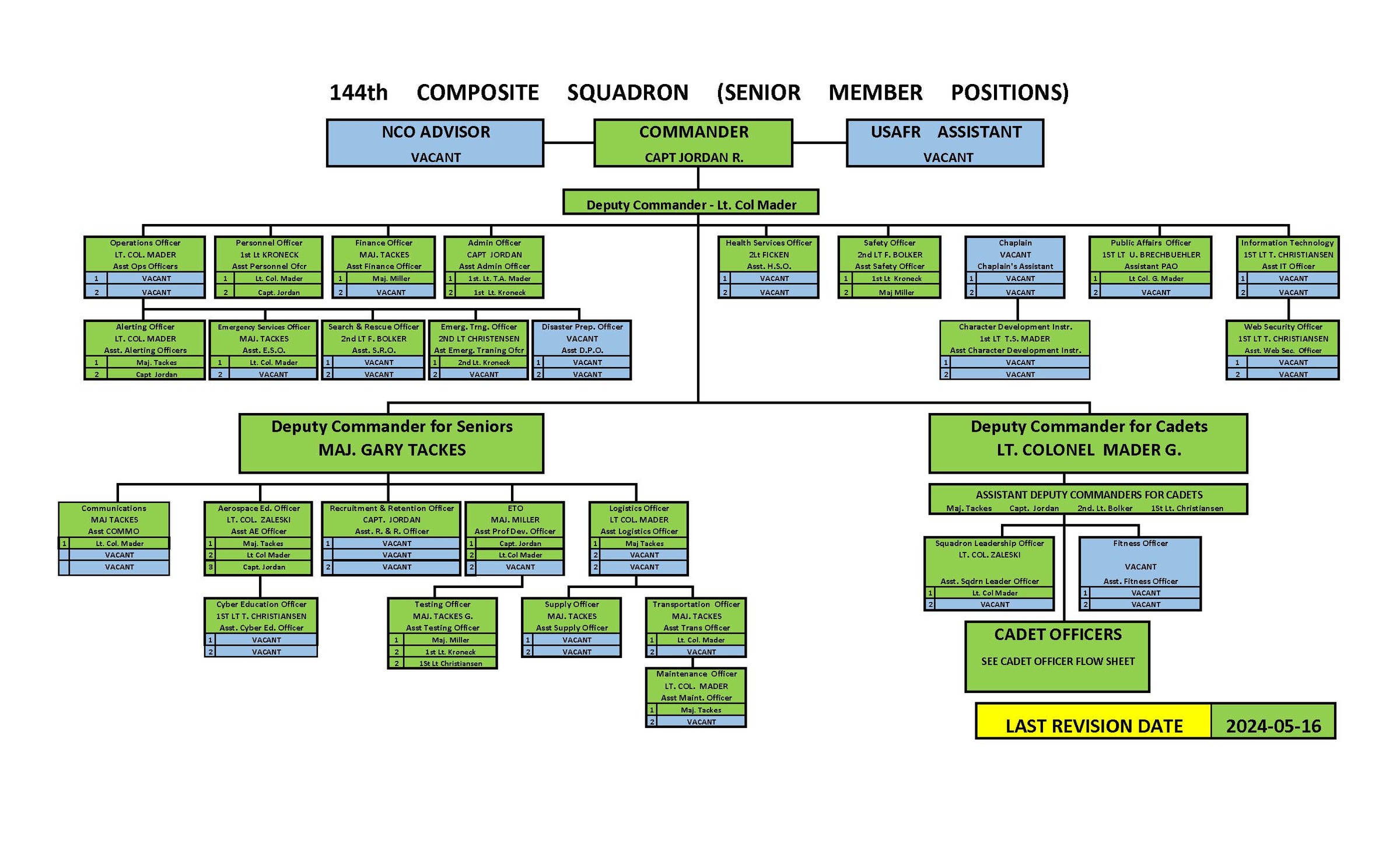
GLR-WI-144 Senior Staff
Squadron Commander
Squadron commanders are responsible to the Corporation and to the wing commander (or group commander if applicable) for ensuring that the Corporation objectives, policies, and operational directives are effectively executed within their squadron. They shall:
- Establish plans, policies, and procedures necessary to the fulfillment of the CAP mission, which are not in conflict with the directives of higher headquarters.
- Keep informed of the accomplishments, problems, and degree of compliance with regulations and other directives through personal observations, inspections, reports, and staff meetings.
- Comply with all policies, regulations, and directives of higher headquarters and require the same compliance by all members of the squadron.
- Ensure safety of personnel and equipment through compliance with directives and policy guidance; ensure an effective safety awareness, education, and inspection program within the unit.
- Select personnel to fill authorized staff positions and remove from staff position those members deemed unqualified or otherwise unsuitable to continue in their positions.
- Establish policies and procedures to ensure an effective squadron recruiting and retention program.
- Coordinate the activities of staff officers to prevent overlapping of functions and to resolve conflicts.
- Eliminate members whose continued membership is determined undesirable in accordance with the provisions of CAPR 35-3.
- Identify members for nonrenewal where continued membership is averse to the best interests of CAP in accordance with provisions of CAPR 39-2.
- Determine meeting dates and attendance requirements for squadron meetings in accordance with policies established by higher headquarters.
- Ensure that new personnel are properly introduced to CAP and make frequent checks on their progress.
- Ensure that squadron property and funds are properly safeguarded and accounted for. Initiate requests for promotion of squadron members.
- Ensure proper wear of the uniform and that violations are promptly corrected.
- Ensure that complaints and grievances are resolved fairly, impartially, and promptly. Initiate recommendations for awards and decorations for squadron members
- Initiate organization actions affecting their squadron (charter redesignations, address changes, etc.).
- Refer to the next higher headquarters problems that cannot be resolved at squadron level.
- Promote an understanding and appreciation of CAP in the local community.
- Promote aerospace education.
Squadron commanders should be familiar with the Civil Air Patrol Constitution and Bylaws, CAP governing directives, and all policy matters affecting their command.
NOTE: The duties above also apply to the deputy squadron commander. Squadron commanders should develop a detailed position description for their deputy, outlining his/her specific duties and responsibilities in support of the overall squadron mission.
Commander: Capt Richard Jordan
NCO Advisor
Squadron NCO provides leadership, management, and guidance in organizing, professional development, training, and utilization of the squadron’s NCO Corps members. Squadron NCO’s will:
- Participate in the decision-making process, as appropriate, on technical, operational and organizational issues.
- Work closely with their commander and their group’s NCO advisor and/or wing’s command NCO.
- Perform other duties as directed by the squadron commander.
- Encourage NCO mentorship of cadets and junior officer CAP members.
- Encourage the recruitment of enlisted service members currently serving or retired from military service for CAP membership.
Primary: Vacant
Special Staff Officers
Personnel Officer
Manages and administers the CAP personnel program and associated administrative procedures to include:
- Membership records and applications
- Confidential screening (FBI fingerprint cards) Organizational actions (charters, deactivations, etc.) Appointments
- Promotions and demotions
- Awards and decorations
- Duty assignments
- Transfers
- Retirements
- Membership terminations/Adverse Actions
- Uniforms
The personnel officer at all levels should be familiar with the Constitution and Bylaws, CAPP 200, and CAP directives in the 30, 35, and 39 series.
Primary: 1st Lt Noelle Kronek
Assistant(s): Lt Col Gerhard Mader, Capt Richard Jordan
Recruiting & Retention
Formulates plans and establishes policies, procedures, and programs, designed to assist CAP in attracting new members and retaining current members at the unit level. They shall:
- Plan and conduct periodic membership drives and open houses to attract new members and to stimulate interest in current inactive members.
- Serve as the content provider for unit web site content pertaining to joining Civil Air Patrol and any other new member information, as well as the unit’s point of contact for recruiting matters and new member inquiries.
- Make presentations to outside groups, both youth and adult, to attract new members.
- Stage display booths and provide recruiting coverage at local high schools, shopping centers, air shows, and other public events.
- Follow up with members periodically during their membership year, and especially 60-90 days before renewal.
- Initiate direct, personal contact with individuals expressing an interest in CAP by telephone, internet inquiry, etc. and follow up to ensure that all interested persons are
- fully informed on the CAP program and local unit activities.
- Informally survey members who chose to not renew for reasons and to identify membership issues.
- Maintain a close watch on membership and participation trends to identify “at-risk” members before they reach the end of their membership year.
- Advise their respective commander on guidance from higher headquarters and statistics and trends related to recruiting and retention.
The recruiting and retention officer should be familiar with all aspects of the Civil Air Patrol program, particularly the CAP Constitution and Bylaws, Civil Air Patrol History, CAPR 30-1, and CAPM 39-2
Primary: Capt Richard Jordan
Assistant(s): Vacant
Information Technology Officer / Website Administrator
IT Officers at all levels are responsible for maintenance, upkeep and compliance with regard to
all CAP IT assets. They shall:
- Ensure that administration of region and subordinate domains are managed in accordance with CAP’s regulatory requirements, Region and Wing Procedures.
- Responsible for setting password policies for local field developed applications/systems to ensure user access is controlled and restricted to authorized users.
- Ensure all members with access to confidential data have a business requirement for the information and take reasonable steps to protect it.
- Ensure develop and maintain a reasonable capability to address system interruptions of locally developed applications.
- Ensure that anti-virus protection is operational on all CAP issued computers. Assist members with hardware/software issues.
The IT Officer should be familiar with NHQ IT governance bodies and responsibilities, CAPR 120- 1, Information Technology Security, CAPR 1-2(I), Personally Identifiable Information, CAPR 1-3, Disclosure of confidential Information by Volunteer Members, and CAPR 1-1, Ethics Policy.
Officer: 1st Lt Temish Christiansen
Assistant: Vacant
Health Services Officer
Responsible for advising CAP commanders and units on the health, sanitation and hygiene of CAP members relevant to CAP activities. (See CAPR 160-1(I) for policy on emergency medical treatment). They shall:
- Assists the ES Officer in arranging or providing training in first aid and emergency lifesaving measures to include medically recognized cardiopulmonary resuscitation (CPR) techniques.
- Provide bloodborne pathogen protection training including preventive measures.
- Report bloodborne pathogen exposures and ensure that those members exposed obtain appropriate follow-up medical care from non-CAP sources.
- Advise members to obtain necessary physical examinations from their personal physicians and to complete emergency treatment consent forms where required by regulation to participate in various Civil Air Patrol activities. NOTE: Under no circumstances will CAP medical personnel perform physical examinations as part of their Civil Air Patrol duties.
- Arrange for necessary medical training materials. Supplies and equipment for unit missions or special activities.
- Maintain first aid kits for medical emergencies. (See CAPR 160-1(I) for policy on emergency medical treatment.)
- Generally advise commanders and unit personnel on preventive medicine matters relevant to CAP activities.
- Plan conferences and meetings pertaining to health services.
Health Services Officers should be familiar with all CAP directives in the 160-1 (I) series and applicable portions of CAPRs 60-3, and 60-5.
Primary: 2d Lt Timothy Ficken
Assistant(s): Vacant
Testing Officer
The squadron testing officer is a member of the squadron commander’s special staff or may be assigned to the deputy commander for cadets in a composite squadron. They shall:
- Obtain, administer, safeguard, and return education and training materials used in Civil Air Patrol.
- Administer the testing program in accordance with CAP directives.
- Monitor cadet use of online testing programs; ensure new cadets are informed how to access online tests; assist cadets who are “locked-out” of eServices. (Cadet and Composite Squadrons)
- Monitor cadet progression and test scores; serve as a tutoring coordinator for cadets requiring extra assistance. (Cadet and Composite Squadrons)
- If a cadet has special educational needs, conferring with the parent, and if necessary, recommending testing accommodations to the squadron commander. (Cadet and Composite Squadrons)
The testing officer should be familiar with the provision of CAPR 40-2, CAPR 40-1, and CAPR 60- 1. An optional, more in-depth position description, complete with reading lists, is available in CAPP 60-15, Cadet Program Officers’ Handbook & Specialty Track Guide.
Primary: Maj Gary Tackes
Assistant(s): Maj John Miller, 1st Lt Noelle Kroneck, 1st Lt Temish Christiansen
Historian
The Historian duties include:
- Preparation of annual histories, which are mandatory for wings and optional for regions and other units.
- Assemble and maintain copies of CAP historical documentation, to include archival materials, artifacts, and both written and oral histories.
- Prepare historical material for purposes of orientation, building esprit de corps, developing Civil Air Patrol’s public image, assist in matters of heraldry, and to support to executive decision-making.
- Complete all duties with objectivity, critical evaluation and a full appreciation of the importance of factual data in the preparation of historical narratives and reports.
- Provide assistance and advice concerning research; prepare lectures, papers, and staff studies; and assist with activities that require historical knowledge or the use of historical materials.
- Develop increased interest in, and an improved understanding of, CAP history through historical programs and social media.
Historians should be familiar with CAPR 110-1, Civil Air Patrol History Program, CAPR 110-2, Historical Repositories, and CAPR 110-3, Civil Air Patrol Heraldry Program.
Historian: Vacant
Safety Officer
Assists and advises the commander in administering CAP’s Safety Management System in accordance with CAP directive and non-directive guidance. In this role, they:
- Work directly with the commander as a key member of the commander’s staff and serves as the commander’s expert on Safety Risk Management (SRM) and the CAP SMS.
- Ensure proper application of SRM throughout all CAP activities and missions by monitoring and assisting subordinate units, if applicable, in administration and compliance with CAP SMS requirements and guidance.
- Direct and perform safety inspections and surveys of operational areas for hazards.
- As Region and Wing Safety Officers, direct reviews of safety-related reports and ensure report narratives are factual, reviews are comprehensive, and corrective actions are relevant to contributing factors.
- Plan operational risk safety briefings to make personnel aware of hazards for various activities and provide safety education that teaches the requirement for safe practices on various topics.
- Review and analyze safety reports for trends and other prevention information.
- Provide and publicize safety awareness information through various means, but not limited to newspapers, posters, etc. and familiarize CAP members with online safety education programs in CAP’s Safety Management System (SMS).
The safety officer should be familiar with CAP directives in the 160 series, as well as any other guidance that contains safety-related information.
Primary: 2d Lt Foster Bolker
Assistant(s): 1st Lt Noelle Kroneck, Maj John Miller
Character Development Instructor
The Character Development Instructors are part of the CAP Chaplain Corps but have different qualifications and different responsibilities than chaplains. CDIs will:
- Complete training requirements for character development instructors.
- Present character development lessons for cadets in the absence of a Chaplain.
- Provide non-clergy support to assist chaplains in providing ministry to the CAP community.
- Assist the Chaplain as part of the CST on Emergency Services missions, if the CDI is a qualified Chaplain Support Specialist (CSS).
- Perform CDI duties under the direction of a chaplain when one is assigned to their unit. When a chaplain is not assigned, the CDI works under the direction of the unit commander and wing chaplain.
Primary: 1st Lt Tania Mader
Assistant(s): Vacant
Administrative Officer
Implements, manages, and directs administrative services activities. They shall:
- Implement administrative policies and procedures.
- Control correspondence (including messages)
- Prepare and authenticate administrative authorizations.
- Prepare local publications and forms.
- Perform related duties as assigned by the unit commander.
The administrative officer should be familiar primarily with CAPP 205 and CAP directives in the 5 and 10 series.
Primary: Capt Richard Jordan
Assistant(s): 1st Lt Tamara Mader, 1st Lt Noelle Kroneck
Public Affairs Officer
Reports directly to the commander at all echelons of command and as such, is the adviser to the commander on all internal and external public affairs matters. They shall:
- Work with the commander on all public affairs matters.
- Implement and manage a Public Affairs Program and support the Wing, Region and National Public Affairs initiatives.
- Conduct an Internal Information Program to develop strategies that emphasize CAP’s importance, member recognition retention and encouragement of member participation in unit, wing, region and national activities and training.
- Conduct an External Information Program to include Media and Community Relations. Develop goals and initiatives that help build relationships with external constituencies of CAP and emphasize its importance in the performance of its missions.
- Ensure National's Public Affairs objectives and missions are met.
- Supervise and assist all subordinate unit public affairs activities.
The Public Affairs Officer, to be effective, must be familiar with all CAP publications and policies pertaining to public affairs, and complete training opportunities presented.
Primary: 1st Lt Urs Brechbuehler
Assistant(s): 1st Lt Tania Mader
Finance Officer
Responsible for overall financial management of the unit program. They shall:
- Serve as a member of the unit finance committee
- Ensure accounting controls are adequate
- Ensure authorized approvers list and all policies have been sent to wing
- Ensure the finance committee meets and records minutes at least quarterly
- Ensure all expenses are properly approved and that expenses over $500 are approved by the finance committee
- Ensure the annual budget is developed, reviewed quarterly and sent to wing
- Review all reports sent by the wing for accuracy and completeness
- Ensure all deposit documentation is sent to wing timely to enable proper classification
- Ensure all reporting requirements and deadlines are met
The finance officer must be familiar with CAP regulations in the 173 series and CAPP 202.
Primary: Maj Gary Tackes
Assistant(s): Maj John Miller
Deputy Commander for Seniors
Primary: Maj Gary Tackes
Assistant(s): Maj John Miller
Operations Officer
Manages and directs all operations activities. They shall:
- Develop and implement operations plans, programs and directives.
- Establish reporting procedures to determine the success of operations programs.
- Coordinate operations matters with other staff agencies or interested agencies.
- Develop standard operating procedures for the control and operation of CAP aircraft.
- Develop necessary operations policies and procedures to ensure mission accomplishment and to provide adequate guidance to subordinate personnel and units.
- Request the issuance of transportation and mission authorizations as requested.
- Supervises the sUAS Officer
- Supervises the Emergency Services Officer
The operations officer should be familiar with CAPP 2 and CAPP 70-3; CAPRs 60-3, 60-5, 60-6, 70-1, 77-1, 100-1, 100-3, 111-1, and 130-2; Operations CAP Standards, ES Task Guides; applicable federal, state and local MOUs, applicable FEMA publications. FAA Parts 1, 43, 61, 91, and 107; and FAA Advisory Circulars in the 61, 91, 97 and 107 series.
Primary: Lt Col Gerhard Mader
Assistant(s): Vacant
Emergency Services Officer
Assists the Operations Officer in managing and directing emergency services activities. They shall:
- Develop agreements with agencies responsible for search, domestic emergencies, and civil defense.
- Develop and maintain an adequate emergency service force.
- Effectively implements nationally standardized programs related to Emergency Services, to include pilot training, and proficiency, standardized training programs to ensure that highly qualified ES personnel are available for search and rescue, and disaster relief missions.
- Develop standardized plans and standard operating procedures to support the wing’s emergency services program.
- Maintain records to determine the status of resources (personnel, vehicles aircraft, radios and other emergency equipment) available for ES missions.
- Develop and maintain a rapid alerting system for assembling necessary resources in a timely manner.
The emergency services officer should be familiar with CAPP 2 and CAPP 70-3; CAPRs 60-3, 60- 5, 70-1, 77-1, 100-1, 100-3, 111-1, and 130-2; Operations CAP Standards, ES Task Guides; applicable federal, state and local MOUs, applicable FEMA publications, and ES related MOUs and agreements.
Officer: Maj Gary Tackes
Assistant: Lt Col Gerhard Mader
Search and Rescue Officer
Assists the ES officer in managing and directing search and rescue activities. They shall:
- Assist the ES Officer in developing SAR agreements with state emergency management officials and other CAP units, if needed.
- Know CAP SAR responsibilities in their respective areas of operation.
- Develop a unit SAR force that can respond to requests from the appropriate Rescue Coordination Centers or other responsible agencies.
- Ensure the SAR training program is adequate.
- Develop standardized operational procedures for rapid alerting and assembling of SAR task force personnel.
- Assist the ES Officer in coordinate wing SAR evaluations, training missions, and exercises.
The search and rescue officer should be familiar with CAPP 2 and CAPP 70-3; CAPRs 60-3, 60-5, 70-1, 77-1, 100-1, 100-3, 111-1 and 130-2; ES Task Guides; applicable SAR federal, state and local MOUs, and applicable FEMA publications.
Primary: 2d Lt Foster Bolker
Associate(s): Vacant
Emergency Services Training Coordinator
Assists the ES Officer in managing and directing ES training activities. They shall:
- Documents that standardized training is accomplished and qualifications earned.
- Coordinate with the Operations Staff to ensure that the implemented nationally standardized training programs are adequate.
- Coordinates with external agencies for other beneficial training.
- Track SQTRs and CAPF 101s for currency and keep the members apprised of their qualification status.
- Coordinates inputs to the annual training and flying plan across other operations staff areas and assists the DO in requesting inputs from other staff directorates.
The ES training officer should be familiar with CAPP 2 and CAPP 70-3; CAPRs 60-3, 60-5, 60-6, 130-2, 70-1, 77-1, 100-1, 100-3, and 111-1; Operations CAP Standards, ES Task Guides; applicable federal, state and local MOUs, applicable FEMA publications. FAA Parts 1, 43, 61, 91, and 107; and FAA Advisory Circulars in the 61, 91, 97 and 107 series.
Primary: 1st Lt Temish Christiansen
Assistant(s): 1st Lt Noelle Kroneck
Disaster Preparedness Officer
Assists the ES Officer in managing and directing disaster preparedness activities. They shall:
- Assist the ES Officer in developing agreements with state emergency management officials pertaining to natural disaster and civil defense activities.
- Develop a unit disaster preparedness force capable of responding to appropriate requests.
- Ensure the civil defense and natural disaster training programs are adequate.
- Assist the ES Officer in developing operational procedures for rapid alerting and assembling of disaster preparedness task force personnel.
- Coordinate wing DR evaluations, training missions, and exercises.
- Know disaster preparedness responsibilities of CAP in areas of operation.
The disaster preparedness officer should be familiar with CAPP 2 and CAPP 70-3; CAPRs 60-3, 60-5, 70-1, 77-1, 100-1, 100-3, 111-1, and 130-1; ES Task Guides; applicable DR related federal, state and local MOUs, and applicable FEMA publications.
Primary: Vacant
Assistant(s): Vacant
Homeland Security Officer
Manages HLS and monitors and supports emergency services activities. This includes:
- Working closely with the other operations staff officers to prevent duplication of effort and to ensure CAP presents one clear voice to potential Homeland Security customers.
- Developing agreements and maintaining contact with state and local emergency management officials pertaining to HLS. Ensuring coordination with unit Emergency Services Officer regarding requirements.
- Working closely with Emergency Services Officers to ensure unit resources are capable of responding to appropriate requests in support of homeland security.
- Monitoring CAP training to ensure the HLS program is adequate to include, proper equipment (cameras, computers and radios, etc.) and training to accomplish complete aerial and ground photo reconnaissance mission requests.
- Monitoring unit procedures for rapid alerting and assembling of unit personnel to support homeland security tasking requirements.
- Monitoring unit homeland security evaluations, training missions and exercises.
- Knowledge of CAP’s homeland security responsibilities in all operational areas.
The Homeland Security Officer should be familiar with CAPP 2 and CAPP 70-3; CAPRs 60-3, 60-5, 70-1, 77-1, 100-1, 100-3, 111-1, and 130-2; ES Task Guides; applicable federal, state and local MOUs, and applicable FEMA publications.
Primary: Vacant
Assistant(s): Vacant
Alerting Officer
Primary: Lt Col Gerhard Mader
Assistant(s): Maj Gary Tackes, Capt Richard Jordan
Communications Officer
Manages and directs communications activities. They shall:
- Develop and implement standardized communications plans, programs, and directives IAW national communications program directives and in close coordination with command and operations.
- Validate equipment requirements and track acquisition and disposition of communications equipment IAW the Communications Table of Allowances and national communications directives.
- Coordinate communications plans and programs with other staff agencies and with subordinate and higher headquarters.
- Develop operating instructions and guidance, to subordinate units and personnel, as needed to implement higher headquarters directives.
- Collect and report data as needed to determine the effectiveness of communications operations.
- Coordinate frequency authorizations for all radio operations with the HQ CAP spectrum management team.
- Develop a standardized communications training program for unit personnel using nationally approved and provided materials.
- Develop and plan unit participation in communications exercises.
- Coordinate communications conferences, meetings, and workshops as needed or
- directed.
- Monitor unit communications plans and program effectiveness.
- Establish programs to ensure the proper maintenance and operations of unit radio equipment. Coordinate maintenance support with the National Technology Center (NTC) when necessary.
The communications officer should be familiar with CAPP 214; and CAP directives in, 62, 66, 77, and 100 series; CAPRs 60-3, 100-1, 100-3, and 111-1; ES Task Guides; applicable federal, state and local MOUs, and applicable FEMA publications. the NTIA manual of regulations and procedures for Federal Radio Frequency Management, applicable FEMA publications; applicable federal, state, and local MOUs requiring communications support.
Primary: Maj Gary Tackes
Assistant(s): Lt Col Gerhard Mader
Aerospace Education Officer
Directs the aerospace education program at their level of command. They shall:
- Be responsible for all AE programs
- Communicate with the commander to develop an annual budget
- Communicate with unit commander, group AEO or wing DAE
- Select, train and supervise AE assistants to help perform AE
- Work toward completion of Master Rating in the AE Specialty track
- Initiate and support external AE programs in the community
- Recruit Aerospace Education members
- Encourage unit and school participation in Model Rocketry, AE Excellence (AEX) Award and STEM Kit programs
- Encourage and help cadets complete AE requirements
- Promote Teacher Orientation Program (TOP) Flights
- Complete the Yeager Award
- Encourage all senior members to complete the Yeager Award
- Submit nominations for AE awards
- Apply for AFA/CAP unit AE grants
- Complete the AE Activity Report
- Maintain an AE notebook, hard copy or electronic
- Support group/wing/region/national internal and external AE activities
Primary: Lt Col Vincent Zaleski
Assistant(s): Maj Gary Tackes, Lt Col Gerhard Mader, Capt Richard Jordan
Professional Development Officer / Education and Training Officer
Manages and directs the Senior Member Education and Training program at the assigned echelon. They shall:
- Create a positive unit training environment where CAP's adult members can develop their required skills in a comfortable, professional atmosphere.
- Assist with the Level I Onboard modules to ensure that all new adult members receive a thorough orientation and have appropriately assimilated into the unit.
- Coordinate mentors for new adult members and other members as needed.
- Make adult members aware of training material and opportunities available to them through CAP and other sources to prepare them to perform operational missions, staff assignments, and other assigned duties.
- Encourage and assist adult members in taking advantage of all appropriate training.
- Help ensure that CAP provides the best quality training with available resources to support CAP's missions.
- Apply all directives applicable to education and training programs as necessary.
- Understand the structure of the Senior Member Education and Training Program and its component programs, activities, and events. Ensure quick and easy access to applicable forms, directives, resources, and instructions.
- Maintain a unit training library. The library may be electronic, hard copy, or a mix of materials that best meets the needs of members.
- Assist unit members in the proper completion and processing of forms if needed. Maintain unit training records regarding education and training activities.
- Assure proper test administration and security for the unit's adult members.
- Correctly prepare documentation in support of, submit, or assist with the submission of applications for level awards, monitor awards for timely submission, and assist with the timely presentation of awards.
- Coordinates member training with other members of the staff.
- Become a qualified Volunteer University instructor; encourage and assist other unit members to apply.
- Mentor Education and Training Officers in subordinate units, if applicable.
- Approve all wing (or Region) ET activities, ensure subordinate units under their command operate in accordance with CAPR 40-1
The Education and Training officer should be familiar with CAPP 204, CAPR 40-1, and other directives in the 35, 39, 40, 50, 52, 200, 280, and 900 series
Primary: Maj John Miller
Assistant(s): Capt Richard Jordan, Lt Col Gerhard Mader
Logistics Officer
The logistics officer advises the wing commander on the status of their respective property management programs and leads programs in accordance with CAPR 130-1 and wing supplements. They shall:
- Train and oversees subordinate unit property management officers
- Account for property assigned to the wing
- Be responsible for real property management in accordance with CAPR 130-1 When needed, appoint an investigating officer to conduct a report of survey.
- Approve disposal of CAP property donated property or property purchased with non- Federal funds
- Manage transfer or turn-in of property not required to support the wing’s mission
- Possess a solid understanding of CAP’s Operational Mission Resource Management System (ORMS) and be able to instruct and assist subordinate unit property management officers in its features and functions
The logistics officer should be familiar with CAP directives in the series described below:
- Transportation matters.......................................................................130 series
- Property Management and Accountability........................................130 series
- Aircraft Maintenance.........................................................................130 series
- Insurance Matters...............................................................................900 series
- CAP Safety & Risk Management.......................................................160 series
Primary: Lt Col Gerhard Mader
Assistant(s): Maj Gary Tackes
Supply Officer
The supply officer serves at the group and unit level and assists their commander in ensuring proper accountability of CAP property within their unit. They maintain regular and frequent contact with the wing in order to coordinate their property management efforts and stay abreast of national and wing property management policies. They shall:
- Ensure proper accountability for CAP property
- Be proficient in the use and capabilities of the Operational Resource Management System (ORMS)
- Document in ORMS, efforts to reclaim CAP property from deactivated units and inactive/departing members and be responsible for redistribution of recovered property
- Be responsible for receipt, issue, storage and proper disposal of all CAP property except communications gear
- Make recommendations to the commander concerning allocation, redistribution and retirement of unit property
- Complete all property inventory and reporting requirements
The supply officer should be familiar with CAPP 206 and CAP Regulation 130-1 and be knowledgeable of CAP Safety and Risk Management regulations CAPR 160-1 and CAPR 160-2.
Primary: Maj Gary Tackes
Assistant(s): Vacant
Transportation Officer
The transportation officer is the single point of contact for all vehicles entrusted to their care. As such, they serve as the unit fleet manager and are responsible for ensuring all vehicles are safe and roadworthy and prepared to support mission needs. They coordinate with other staff members to determine event schedules and anticipate vehicle support requirements.
They shall:
- Ensure that all COVs are licensed and registered in accordance with applicable laws of the state, commonwealth, or other local government jurisdiction where vehicles are operated
- When designated as approval authorities, review and approve driver’s license applications
- Maintain appropriate records on location of all vehicles
- Ensure routine and major maintenance is accomplished and documented on COVs in accordance with manufacturer’s recommended schedules
- Assist their commander in developing vehicle requirements and in identifying vehicles for disposal
- Ensure timely completion of vehicle usage reports
- Ensure expeditious reporting of vehicle mishaps.
The transportation officer should be familiar with CAPR 130-1 and CAPR 130-3. They should also have a good working knowledge of CAP Safety Regulations CAPR 160-1 and CAPR 160-2.
Primary: Maj Gary Tackes
Assistant(s): Lt Col Gerhard Mader
Maintenance Officer
The aircraft maintenance officer is the single point of contact for all maintenance issues for aircraft entrusted to their care. As such, the AMO is responsible for all inspections, maintenance, upgrades and repairs performed on assigned aircraft. They will exercise staff supervision and coordination for all aircraft maintenance. They shall:
- Assist their commander in developing an aircraft maintenance management program that ensures all scheduled maintenance is performed and discrepancies are promptly corrected
- Make recommendations to the commander for the improvement of the maintenance program
- Be the interface between CAP and all businesses necessary to keep their assigned aircraft mission capable
- Be proficient in the use and functions of aircraft, maintenance, repair, and documentation (AMRAD) system and able to communicate this information to all levels within their unit
- Ensure that all aircraft discrepancies and inspections are entered in AMRAD prior to the work being started and that all aircraft maintenance data is updated and accurate
- Ensure that aircraft status is accurately reflected in AMRAD
- Promptly close-out all discrepancies in AMRAD when work is complete and aircraft is returned to service
- Ensure that CAP aircraft meet FAA standards and are maintained in accordance with CAP Regulations, FARs and FAA–approved manufacturer’s data, to assure continued airworthiness
- Coordinate aircraft inspections, maintenance, upgrades and repairs with CAP/LGM
The AMO must be familiar with CAPR 130-1, CAPR 130-2, CAPP 130-3, Federal Aviation Regulations, FAA Airworthiness Directives, applicable Service Bulletins as determined by CAP/LGM, FAA–approved manufacturer’s data and CAPR 174-1. They should also have a good working knowledge of CAP Safety Regulations CAPR 160-1 and CAPR 160-2.
Primary: Maj Gerhard Mader
Assistant(s): Vacant
Deputy Commander for Cadets
Assists the commander in ensuring the local Cadet Program fulfills mission objectives and regulatory requirements. Instructs, supervises, and mentors cadets on cadet topics. Manages and directs all functions related to the squadron’s Cadet Program. They shall:
- Ensure the squadron is compliant with the Cadet Protection Program requirements
- Select, train, and supervise the adult staff officers who serve cadets as instructors,
- supervisors, and mentors.
- Assist the commander in establishing annual goals for the Cadet Program; monitors and evaluates progress toward the goals’ completion
- Plans and implements local training plans for weekly cadet meetings and cadet special activities or, alternatively, delegates this function to a subordinate
- Serve as parents’ primary point of contact for CAP information (or designates this role to an assistant); ensure parents are kept informed of activities, policies, and other program news
- Serve as the unit commander’s action officer on cadet disciplinary matters, consistent with the progressive disciplinary standards of CAPR 60-1.
- Monitor funds and property used for cadet program.
The deputy commander for cadets should be familiar with all CAP directives, with particular emphasis on the 60-series publications. An optional, more in-depth position description, complete with reading lists, is available in CAPP 60-15, Cadet Program Officers’ Handbook & Specialty Track Guide.
Primary: Lt Col Gerhard Mader
Assistant(s): Maj Gary Tackes, Capt Richard Jordan, 1st Lt Temish Christiansen, 2d Lt Foster Bolker
Aerospace Education Officer
[see above]
Cadet Cyber Education Officer
Responsible for cadet education in cyber defense and related topics to include:
- Academic instruction
- Coaching or mentoring cyber competition teams (e.g., CyberPatriot)
- Special activities in cyber-related topics including technical training, workshops, facility tours, guest speakers, career exploration, etc.
- Mentoring cadet cadre who serve in a cyber or IT-related role
The cadet cyber education officer should be familiar with cyber resources available on the CAP website. An optional, more in-depth position description, complete with reading lists, is available in CAPP 60-15, Cadet Program Officers’ Handbook & Specialty Track Guide.
Primary: Vacant
Assistant(s): Vacant
Leadership Education Officer
Responsible for leadership laboratory of CAP cadets to include:
- Academic instruction using Learn to Lead texts
- Proper wear of the CAP uniform, drill and ceremonies, and military customs and courtesies
- Cadet officer education in the Staff Duty Analysis program
- Mentoring the cadet cadre
- Making cadet cadre assignment recommendations, cadet promotion recommendations, and participating in leadership feedback meetings
The leadership officer should be familiar with the 60-series publications and CAPR 39-1. An optional, more in-depth position description, complete with reading lists, is available in CAPP 60-15, Cadet Program Officers’ Handbook & Specialty Track Guide.
Primary: Lt Col Vincent Zaleski
Assistant(s): Vacant
Fitness Officer
Responsible for cadet physical fitness education to include:
- Academic instruction relating to physical fitness, nutrition, resilience, and related topics
- Instruction on safety procedures for fitness or high adventure activities
- Administration of the Cadet Physical Fitness Test
- Mentoring cadets on fitness performance
- Identifying and mitigating safety risks for fitness-related activities
- Assisting the commander in assigning cadets to their initial physical fitness categories; assisting the commander in assigning and reassigning cadets to fitness categories as their medical limitations change
The fitness officer should be familiar with the 60-50 series publications. An optional, more in- depth position description, complete with reading lists, is available in CAPP 60-15, Cadet Program Officers’ Handbook & Specialty Track Guide.
Primary: Vacant
Assistant(s): Vacant